


With harm reduction initiatives in the federal government's crosshairs and a slimmed-down budget, the Baltimore City Health Department has nonetheless maintained ambitious goals as it looks to curb overdoses.
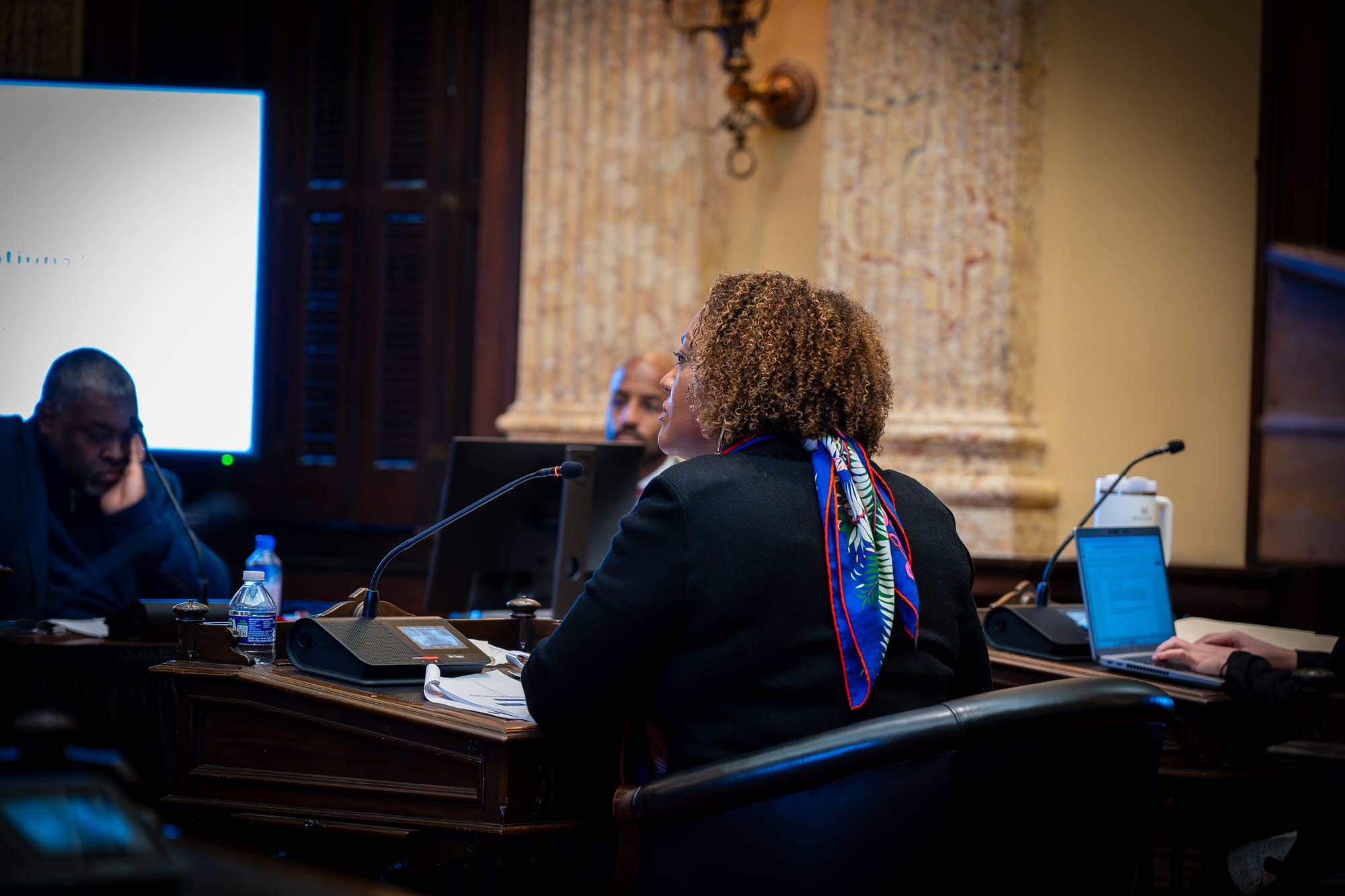
Health Commissioner Dr. Michelle Taylor proudly presented a two-year draft plan to cut fatal overdoses 40% by 2040 to the Baltimore City Council's Committee on Legislative Investigations on Thursday. The plan, first unveiled in July by the Mayor's Office of Overdose Response, came on the heels of historic declines in fatal overdoses in 2024, with last year's numbers showing promise. However, despite uncertainty about whether that trend will hold — and about just how much President Donald Trump's assault on public health will hit Baltimore — the plan just isn't enough for some council members.
"I don't think 40% by 2040 is the number," said Council President Zeke Cohen. "I think Baltimore is better than that. I think we have shown over the last couple of years, with tremendous reductions in violence, that we can beat expectations substantially. We already see this trend where the deaths from overdose are going down in our city."
The plan, expected to be finalized soon, provides a holistic view of the crisis, embodying a ground-up approach. For instance, many of its prevention initiatives focus on general quality of life, such as increasing access to transportation, education, food assistance, employment, and housing.
It recommends bolstering initiatives targeted at those disproportionately affected by the crisis, namely older Black men. It also includes low-barrier, mobile harm reduction and crisis services in addition to brick-and-mortar locations.
Other recommendations include increased data transparency, educational campaigns, expanded 988 services, 24/7 stabilization centers, expanded access to treatment, and better oversight of treatment programs.
"The epidemiologists were involved in that puzzle and had those conversations between themselves, BCMOOR and the mayor's office to make sure that they arrived at a number that was realistic," Taylor said. "We can omit the number, and the plan was always to amend that number if it looked like we needed to be even more ambitious."
Health officials aim to build upon existing progress in combating the overdose crisis. There were 777 overdose deaths in Baltimore in 2024, a 25.5% decrease from the year prior, according to preliminary data.
In the 12-month period ending in October, Baltimore saw 560 deaths. Last year's numbers haven't been finalized, although the existing preliminary data indicate that the downward trend continued throughout much of last year.
Yet the fact that there have been gains in preventing fatal overdoses is the exact reason why the 40% reduction by health officials is problematic to council members.
"When we see from 2023 to 2025, it's decreasing over 50%, clearly 40% by 2040 doesn't make much sense," said Isaac "Yitzy" Schleifer, chair of the Committee on Legislative Investigations.
Isn't it nice that council members are pushing the health department to aim higher?
Their comments came with a hefty dose of irony. They've largely refrained from pushing for drug policy reform, but they seemingly took no issue with cutting the health department's budget by 3.5% last year, leaving it with less than $201 million. At the same time, they approved boosting the Baltimore Police Department's budget by $22 million, bringing it to a monumental $613 million.
One could argue that the hundreds of millions of dollars the city has won from opioid-related lawsuits will address the health department's shortfalls, but that money is not meant to supplant existing funding. In addition, it's less than the cops' annual budget, and those dollars are only a temporary boost that won't provide a consistent stream of funds to combat the overdose crisis down the line.
No amount of money, however, will reach its potential as long as public health is not a priority in Baltimore. The War on Drugs has thrived under the current slate of council members, mirroring the failures of their predecessors. Despite myriad evidence showing that heavy-handed policing drives up fatal overdose rates, they often seem more concerned with clearing corners and pushing back on methadone clinics than actually pursuing drug policy reforms.

But this isn't just about money and the War on Drugs. It's about the numbers themselves.
Although Cohen cited the city's historic decline in violent crime as evidence that the city could drive down overdoses by more than 40% over the next 15 years, it's not that simple.
There is insufficient evidence to support the assertion that trends in violent crime can be extrapolated to those involving overdose death rates. The declines in both areas are also part of a national trend, meaning Baltimore is far from being unique. Given that many other cities are touting massive drops in crime and fewer overdose deaths, one cannot simply attribute the numbers to policies specific to Baltimore.
Fatal overdose trends are also not linear. It was just two years ago that Baltimore saw more than 1,000 overdose deaths — numbers had been increasing for a decade, peaking in 2021 — and it would be foolish to assume that less than two years' worth of data solidifies a downward trend.
And all of this sits against a grim backdrop at the federal level.
Trump signed an executive order in July to criminalize homelessness, ramp up forced institutionalization of those with mental illnesses and substance use disorders, and defund life-saving harm reduction programs.
The same month, the U.S. Substance Abuse and Mental Health Services Administration issued a letter that explicitly mentioned overdose prevention centers, stating that certain harm reduction programs "only facilitate illegal drug use and its attendant harm," so the agency's funds will no longer be used to "support poorly defined so-called 'harm reduction' activities."
Local officials are already shutting the door on much-needed reforms because they fear retaliation, including losing federal funding at a time when they're already operating on a shoestring budget.
The strategic plan to reduce overdoses, for example, contains ambiguous language that would theoretically allow for OPCs. But Scott's recently announced list of legislative priorities omitted legislation to legalize the sites for 2026, with harm reduction advocates announcing last month they wouldn't pursue such bills in the upcoming General Assembly session.
Meanwhile, the mayor has refused to commit to establishing city-sanctioned sites despite multiple avenues to pursue them, and Taylor has more candidly indicated that the city won't pursue OPCs to avoid risking federal funding.
The problem, therefore, lies not in the numbers proposed in the strategic plan but in the individuals who have the power to implement policies to achieve a sustained reduction in overdose deaths.
Members of the city council say they are concerned about the overdose crisis. Yet they don't seem to be concerned about the drug war that sentences those who use drugs to jail cells or graves.
They'll cut public health funding despite knowing that a despot already has public health dollars on the chopping block, and they'll subsequently push health officials to do more with less.
Scott's administration and council members must get on the same page. They can go back and forth over to what extent they want to see overdose death tolls decline, but any proposed numbers are arbitrary without policies that have drug users' livelihoods in their best interest.
If they want to save lives, they must coordinate, cooperate and legislate. And they must do so based on the evidence cited by public health officials and harm reductionists for decades, not the drug war's demand for drug policy regression, crackdowns and more police funding.

Read the last Redux Newsletter: "Baltimore once again balks at OPCs as advocates drop push for state legislation this year"
As Baltimore's top officials wade into the new year, the likelihood of their policy priorities materializing remains unclear. Yet what's certain is that those in power still won't commit to using everything at their disposal to save the lives of those who use drugs.
Mayor Brandon Scott's recently announced list of legislative priorities omitted overdose prevention centers, or OPCs, for 2026. Legislation to legalize the facilities at the state level made the cut in previous years, but harm reduction advocates announced last month that they wouldn't pursue OPC bills in the upcoming General Assembly session. They will instead channel their energy into decriminalizing drug paraphernalia and, after unsuccessfully advocating for state-level legalization for the better part of a decade, the spotlight now rests fully on Baltimore to take matters into its own hands.
It doesn't seem like Scott's administration is prepared to meet that moment.
Read the full newsletter here.
Mobtown Redux's Overdose Data has been updated with the latest local, state and national data
There were 777 overdose deaths in Baltimore in 2024, a 25.5% decrease from the year prior, according to preliminary data.
In the 12-month period ending in November, Baltimore saw 554 deaths, a death rate of 94.6 per 100,000 people. Statewide, there were 1,262 deaths, a death rate of 20.4 per 100,000 people.
The data shows that fatal overdoses continue to trend downward after years of climbing, though poor Black neighborhoods in West Baltimore continue to suffer the most.
Check out Mobtown Redux's Overdose Data Dashboard here.
Click here to learn more about harm reduction resources in the Baltimore area.
Filter: "Oklahoma Bill Would Require EMS to Call the Cops After Reversing an OD"
On January 6 the Senate confirmed Sara A. Carter Bailey as the new “drug czar,” the colloquial title for the director of the Office of National Drug Control Policy (ONDCP), by a vote of 52-48. The former Fox News contributor was nominated by President Donald Trump in March 2025 and is the first woman to lead the ONDCP. She will likely use the position to amplify fentanyl misinformation and conspiracy theories targeting immigrants.
“Under [Trump’s] leadership, we will reassert our fundamental right to live healthy lives,” Carter stated following her confirmation. “We will hold accountable the narco-terrorists who infringe upon this right, participating in the deliberate poisoning of tens of thousands of Americans each year. They will no longer kill our families, friends, neighbors and even children with impunity. At the same time, I will ensure that every parent, family member and child have the resources they need to prevent and combat addiction. I will stand with our brave law enforcement officials, and with every family who has lost a loved one to drug overdose.”
Click here to read the full article.


Comments