


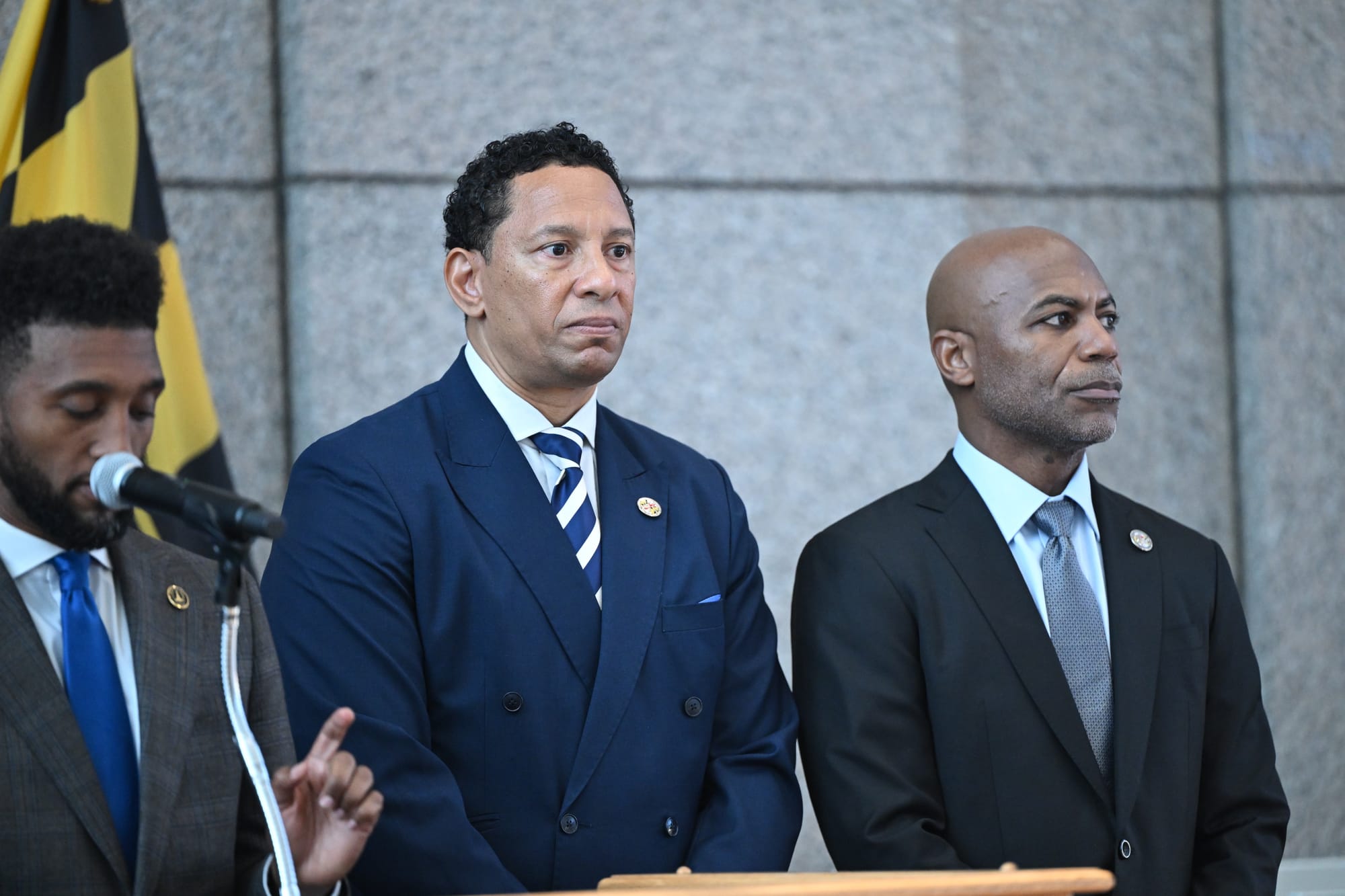
When State's Attorney Ivan Bates took office nearly three years ago, he inherited a historic opportunity. Drug-related arrests had plummeted over the past decade, making it seem as though the War on Drugs in Baltimore was losing steam.
Then, in a move that foreshadowed much of his tenure, he fumbled it. Bates scrapped his predecessor's de facto decriminalization policy, cementing himself as Baltimore's top drug warrior and emboldening the city's notoriously corrupt police force to crack down harder. In his first year in office alone, total drug arrests resulting in charges increased by 91%. Misdemeanor drug charges, which were the subject of the de facto decriminalization policy, increased nearly 20-fold.
Much to the delight of cops and prisons, the numbers have continued to rise since, and more than 90% of those arrested are Black.
“Residents have clamored for a return to accountability,” Bates said upon taking office in 2023. “We don’t have to take a hands-off approach when it comes to quality-of-life crimes.”
Yet Bates' tenure has been a paragon of Baltimore's reckless disregard for public health and human rights under the guise of "public safety." The state's attorney has overseen the decimation of quality of life for many of the city's most vulnerable — all to uphold the image of being "hard on crime."
That's the record he's bringing to the table as he likely seeks re-election.
Although Bates hasn't formally filed to run in 2026, he teased that he'd give it another go during an interview on WBAL News Radio late last month. More recently, he's posted campaign ads and touted drug busts on his Instagram account.
Meanwhile, he's reveled in public spats with Mayor Brandon Scott and is now embroiled in yet another dispute. Earlier this week, he announced he would no longer cooperate with the Mayor’s Office of Neighborhood Safety and Engagement because of a "cloak of secrecy" around the agency that Scott has made a cornerstone of his anti-violence efforts.
Among other things, MONSE oversees programs like the Group Violence Reduction Initiative, or GVRS, and Safe Streets.
There is no doubt that GVRS is flawed. For years, it has served as a vehicle for drug-war policing under the guise of public safety, with the number of arrests far outnumbering the number of those "helped" by the program. Officials have often credited it as a prominent driver for the reduction of violent crime in Baltimore, even though such crime has dropped significantly nationwide.

Unlike GVRS, Safe Streets aims to get cops out of the picture. Studies have shown it to be effective, with it involving a form of community-based violence intervention instead of typical heavy-handed policing. The lack of law enforcement involvement, though, has made the crackdown-hungry incumbent livid.
The only thing Bates has to his name is the citation docket, a program that's failed to make any meaningful difference in how the city handles low-level crimes.
At the end of the day, his ongoing beef with the mayor has nothing to do with public safety, transparency or justice. It's about the incalcitrant incumbent's seemingly insatiable desire to take credit for progress and make headlines through back-and-forths with other elected officials. And he's been effective, with every news outlet in Baltimore writing numerous stories about a couple of letters the pen pals sent each other over the past week.
That should not distract from the fact that, in Bates' first three years in office, he's demonstrated he has no appetite for anything but crackdowns and punitive policies. He's licked the boots of the city's police force while sparring with the mayor over any alternatives to the status quo, illustrating his disillusionment with criminal justice reform.
His reckless disregard for human rights, criminal justice reform and the law is nothing new.
In a Nov. 10 Facebook post about local law enforcement mulling alternative ways to "clear corners, which was found to be racist and unconstitutional nearly a decade ago, here's what he had to say:
"Our residents are tired of having to come outside their doors to navigate through a crowded block of individuals selling drugs on street corners which many don’t even live," Bates wrote. "I believe it is reasonable to ask that anyone convicted of these crimes, who do not live in this area, are prohibited from that area for the term of their probation to ensure a better quality of life for the law abiding citizens of these communities."
So, a self-described man of law wants to tweak a racist and unconstitutional practice all in the name of "quality of life." He wants to restrict the rights of individuals — even those who haven't been convicted — to uphold his version of "justice."
But "justice" and "quality of life" are terms Bates doesn't understand. Justice isn't encouraging crackdowns and infringing on people's rights. And it's not enhancing quality of life if the practices involve throwing people in jails and prisons amid ongoing mass incarceration.
To say Bates, whose office has repeatedly dodged questions about his role in the drug war, is unfit for a second term is an understatement.
With an unscrupulous police force running roughshod in the city and fanning the flames of the drug war, a primary challenger from the left is required to bring some semblance of sanity back to the city's criminal justice system. It needs what many would hesitantly call a "progressive prosecutor."
The term is problematic because no individual tasked with upholding the punishment bureaucracy is a true progressive. But as former State's Attorney Marilyn Mosby demonstrated, a top prosecutor can push back against the worst that the bureaucracy has to offer — things Bates happily upholds.
There was backlash against reform-minded prosecutors over public perceptions of crime during the COVID-19 pandemic, but it's imperative that cities like Baltimore revisit that movement.
Mosby was far from perfect. She failed to secure convictions in the cases against officers who murdered Freddie Gray and was hellbent on convicting Keith Davis Jr., an innocent man. She also may or may not have committed some mortgage fraud.
She was, however, relatively solid on drug policy. Though police still targeted Black Baltimoreans, she halted the prosecution of low-level crimes and disincentivized police from pursuing their drug-war tactics. She wasn't perfect, but she showed that prosecutors can, in fact, fight back.
Simply primarying Bates from the left isn't going to end that war, nor is it going to bring immediate reforms to the deeply flawed "justice" system. But as Mosby's performance at the polls showed, there is an appetite to move away from the status quo.
It's December, and next year's elections aren't far away. There's no time to waste in finding someone — and organizing behind someone — who can make Bates a one-term state's attorney.

Read the last Redux Newsletter: "You don't have to be sober for the holidays — but use safely"
With America's beloved celebration of colonialism in the rearview mirror and Christmas right around the corner, the holiday season is in full swing. And these can be difficult times for both former and active drug users.
When I first launched Mobtown Redux, I published a piece titled "Sober for the holidays," which detailed how the holiday season can be a trying time for those of us in abstinence-based recovery. Holiday celebrations are full of temptations, whether it be drugs or alcohol, and the season can also bring about a resurgence of trauma from times past. For many, these serve as triggers that create the perfect storm for a relapse.
That article is no longer online, but I stand by my point. On the other hand, as I've become more ingrained in the harm reduction movement, it's become evident that the article failed to acknowledge that sobriety isn't the only path forward for those who use substances — nor should it be.
Read the full newsletter here.
Mobtown Redux's Overdose Data has been updated with the latest local, state and national data
There were 777 overdose deaths in Baltimore in 2024, a 25.5% decrease from the year prior, according to preliminary data.
In the 12-month period ending in October, Baltimore saw 560 deaths, a death rate of 95.2 per 100,000 people. Statewide, there were 1,290 deaths, a death rate of 20.9 per 100,000 people.
The data shows that fatal overdoses continue to trend downward after years of climbing, though poor Black neighborhoods in West Baltimore continue to suffer the most.
Check out Mobtown Redux's Overdose Data Dashboard here.
Click here to learn more about harm reduction resources in the Baltimore area.
Filter: "Baltimore Drug Users Want Safe Supply, Know How It Should Look"
People who use drugs in Baltimore, overwhelmingly support prescribed safe supply programs, according to new research. Published in the International Journal of Drug Policy in October, the study highlighted how the most vulnerable respondents were the most supportive of the idea—and dug into the specifics of what people want.
Researchers based in Baltimore and Canada surveyed 300 city residents who had injected drugs in the past year, most of whom continued to do so. They found that 87 percent would support programs providing access to regulated drugs, in order to protect participants from the adulterated street supply.
Click here to read the full article.

Comments