


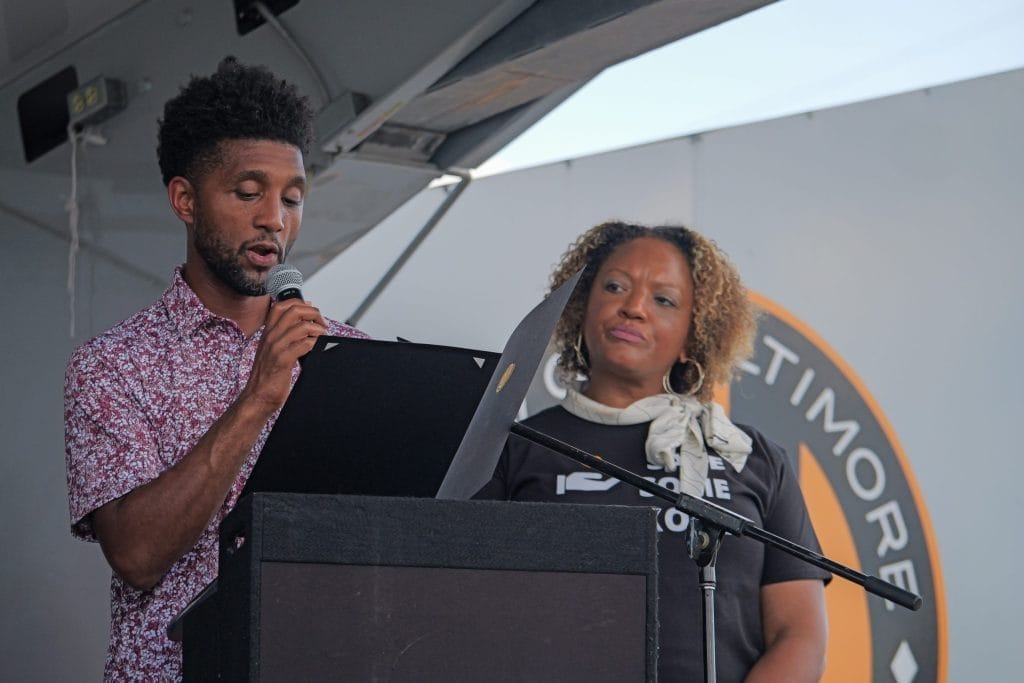
As Baltimore's top officials wade into the new year, the likelihood of their policy priorities materializing remains unclear. Yet what's certain is that those in power still won't commit to using everything at their disposal to save the lives of those who use drugs.
Mayor Brandon Scott's recently announced list of legislative priorities omitted overdose prevention centers, or OPCs, for 2026. Legislation to legalize the facilities at the state level made the cut in previous years, but harm reduction advocates announced last month that they wouldn't pursue OPC bills in the upcoming General Assembly session. They will instead channel their energy into decriminalizing drug paraphernalia and, after unsuccessfully advocating for state-level legalization for the better part of a decade, the spotlight now rests fully on Baltimore to take matters into its own hands.
It doesn't seem like Scott's administration is prepared to meet that moment.
“Mayor Scott is unequivocal in his support of overdose prevention centers as a tool in the toolbelt to keep people alive, and the administration is exploring all possible avenues for how to do it in Baltimore," the mayor's office told Mobtown Redux in a statement.
In the absence of state law, researchers have suggested that Baltimore could establish city-sanctioned facilities by issuing an emergency declaration to permit OPCs unilaterally. New York City also demonstrated in 2021 that coordinated efforts among city agencies can make it possible.
The mayor's refusal to commit to city-level reforms introduces more uncertainty two months after Health Commissioner Dr. Michelle Taylor indicated that the city would abandon attempts to provide life-saving spaces for drug users because of fears they could risk federal funding under President Donald Trump's authoritarian regime.
Trump signed an executive order in July to criminalize homelessness, ramp up forced institutionalization of those with mental illnesses and substance use disorders, and defund life-saving harm reduction programs.
The same month, the U.S. Substance Abuse and Mental Health Services Administration issued a letter that explicitly mentioned OPCs, stating that certain harm reduction programs "only facilitate illegal drug use and its attendant harm," so the agency's funds will no longer be used to "support poorly defined so-called 'harm reduction' activities."
“While local public health would love to do everything that could potentially fit under our umbrella, we always have to be cognizant of who’s in office right now, not only federally but at the state level and city level,” Taylor said in an October interview, before it was known that state legislation would not be introduced.
“I want to be compassionate,” she continued. “But does being compassionate mean that we are not going to be able to maintain our levels of federal funding, where we need to do all of the other services that we need to do?”
Despite an increased sense of urgency among harm reductionists in the aftermath of three mass overdose events last year, the city's failure to seize the moment and wholeheartedly pursue OPCs is nothing new.
This summer, the mayor's administration offered a similar response when it tiptoed around the idea of city-sanctioned facilities, one of many responses that indicated it would not commit to establishing sites in Baltimore. Those comments came on the heels of Councilman Ryan Dorsey ramping up his rhetoric in support of the sites, with other council members also appearing to warm up to the idea of OPCs in recent months.
Contrary to what many believe, these are not radical demands. The efficacy of overdose prevention centers is backed up by a plethora of research, which shows they reduce HIV and hepatitis transmission, prevent overdose deaths, and reduce public use of drugs.

As the future of OPCs in Baltimore looks grim, the one thing that the city has continued to rally behind is the decriminalization of drug paraphernalia, which Mayor Scott has once again named as a legislative priority in 2026. Unlike OPC legislation, it's had some legislative success, clearing both chambers in 2021 before being vetoed by former Gov. Larry Hogan.
Still, as evidenced by the tenure of former State's Attorney Marilyn Mosby, decriminalization as a whole is another issue the city could take into its own hands — if not for State's Attorney Ivan Bates, a known drug warrior who is running for re-election this year.
To some Baltimore officials, the existence of state legislation has served as an off-ramp allowing them to circumvent demands for reform-minded governing at the city level. Trump's tenure has gifted them another excuse, and they've proven they're more than willing to abide by the dictums that come down from the White House at the expense of drug policy reform.
Drug users are caught in the middle of all this, left to rot with a tainted drug supply because the city fears an authoritarian regime. The moment could mark a wasted opportunity amid a historic decline in overdose deaths.
There were 777 overdose deaths in Baltimore in 2024, a 25.5% decrease from the year prior, according to preliminary data.
That trend has seemingly continued. In the 12-month period ending in November of last year, Baltimore saw 554 deaths, a death rate of 94.6 per 100,000 people.
That death rate remains astronomically high, and the data also shows that poor Black neighborhoods in West Baltimore continue to suffer the most.
Even though the number of overdose deaths quadruples that of homicides in Baltimore, officials are significantly more focused on a historic drop in violent crime than on the overdose crisis. An important lesson to be found in both trends is that the reductions are part of national declines that could easily reverse without advancements in policy.
This is no longer just about public health — it's about whether Baltimore is willing to fight back against an oppressive regime to protect its most vulnerable. And every day that reforms are stalled because of fears of retaliation, people die. And then more will die. And then some more.
To those in power, these drug-using constituents apparently don't hold as much value as those who want to develop property or demand heavier-handed policing. There are unlimited dollars and bill-signing events for those individuals, all while those who use drugs have been left with stagnant drug policy and an ever-changing drug supply that threatens their lives.
The foundation of the harm reduction movement is the belief that these people hold equal value, deserve equal compassion and should be afforded equal rights. That's why we fight for overdose prevention centers, decriminalization and more funding to serve our comrades who use drugs.
Hundreds of millions of dollars in restitution funds, spread out over 15 years and totaling less than the police department's annual budget, will not solve this issue. Ambitious policies that combat the War on Drugs and the punishment bureaucracy are the only true solution.
So, if the city truly wants to act in drug users' best interests, how far are those in power willing to go to prove it?

Read the last Redux Newsletter: "Mobtown Redux to partner with Scalawag Magazine in 2026"
After three years of independent and uncompromising harm reduction journalism, Mobtown Redux will have a new comrade in the fight against the War on Drugs in Baltimore.
Starting in January, Mobtown Redux and Scalawag, an abolitionist magazine covering oppressed communities in the South, will co-publish the weekly Redux Newsletter. Through this partnership, the publications aim to bolster Mobtown Redux's coverage of addiction, drug policy and the harm reduction movement in Baltimore — all while paving the way for a new wave of reporting that advocates for drug users in the South and beyond.
Read the full newsletter here.
Mobtown Redux's Overdose Data has been updated with the latest local, state and national data
There were 777 overdose deaths in Baltimore in 2024, a 25.5% decrease from the year prior, according to preliminary data.
In the 12-month period ending in November, Baltimore saw 554 deaths, a death rate of 94.6 per 100,000 people. Statewide, there were 1,262 deaths, a death rate of 20.4 per 100,000 people.
The data shows that fatal overdoses continue to trend downward after years of climbing, though poor Black neighborhoods in West Baltimore continue to suffer the most.
Check out Mobtown Redux's Overdose Data Dashboard here.
Click here to learn more about harm reduction resources in the Baltimore area.
Filter: "Whether DOJ Reschedules Marijuana 'Remains to Be Seen,' Per CRS Report"
In the days since President Donald Trump signed an executive order on marijuana rescheduling earlier in December, there’s been some misreporting that the deal is officially done. But as congressional researchers note in a new report, the reclassification must still be finalized—and there’s a chance the Justice Department could opt to start the process all over again, or even not complete it at all.
What the president did through executive action was direct the attorney general to expeditiously complete the process of moving cannabis from Schedule I to Schedule III of the Controlled Substances Act, in accordance with a proposed rule initiated under the Biden administration. Short of that sign-off, marijuana remains a Schedule I drug.
Click here to read the full article.

Comments